After the team had all of the communications ready to develop the game, we had to start creating the game that we had decided on with the presentation. A parkour movement based game with time trials. This idea, as state in the PowerPoint, was inspired by multiple games, such as Mirrors Edge, Dying Light and Superhot.
I started off by creating a basic player movement script. I checked online to see the popular way of creating it, either using a RigidBody for physics based movement or a Player Controller for more locked and easier to implement movement. I used Brackeys tutorial to try out a Player Controller based movement script, but used a combination of “Dani” and “Alexander Zotov” on YouTube to create a player movement script that takes advantage of a RigidBody, Colliders and a Ground Check.
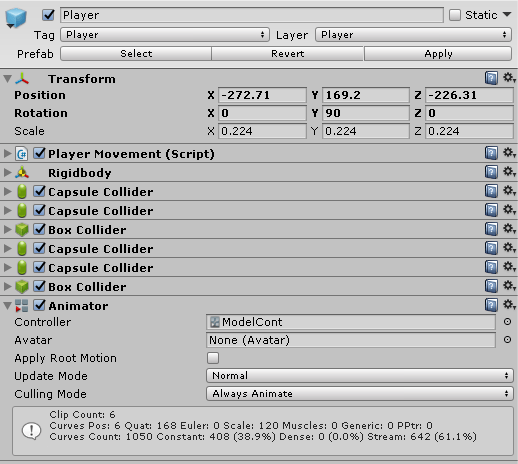
Once I had this working inside of Unity 2019, I had to begin to change the code in certain ways so that I could downgrade the scripts to Unity 2017 for the rest of the team to be compatible with.
After that, I decided that the best thing to add to next, is the most basic, but fun parkour movement. “Wall Running”. I experimented with a couple of ideas based off of my own inspiration, dealing with a box collider on either side of my body to deal with left and right collision, but decided that this would not be the best as it could become problematic due to whenever the player is scaled during a slide, so i began to do research into Raycasting inside of Unity.
After some testing, I used a raycast, originating from the centre of my body, stored inside of a variable, pointing outwards, using transform.right and !transform.right, to port 2 separate raycasts on either side of my body, telling me whether a wallrun has been activated on my left or right, so that I can activate the wallrun animation and script for either wall and only one at a time.
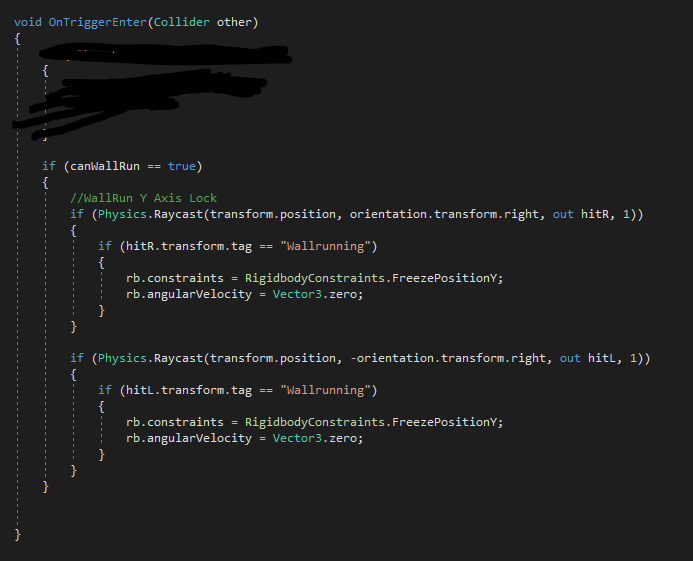

This allowed me to animate the player camera with a small tilted rotation to make the wall run feel a lot more natural, rather than just being glued to a wall by your hip. It also allowed me to make sure that my scripts always knew the orientation of my character no matter where they were.

